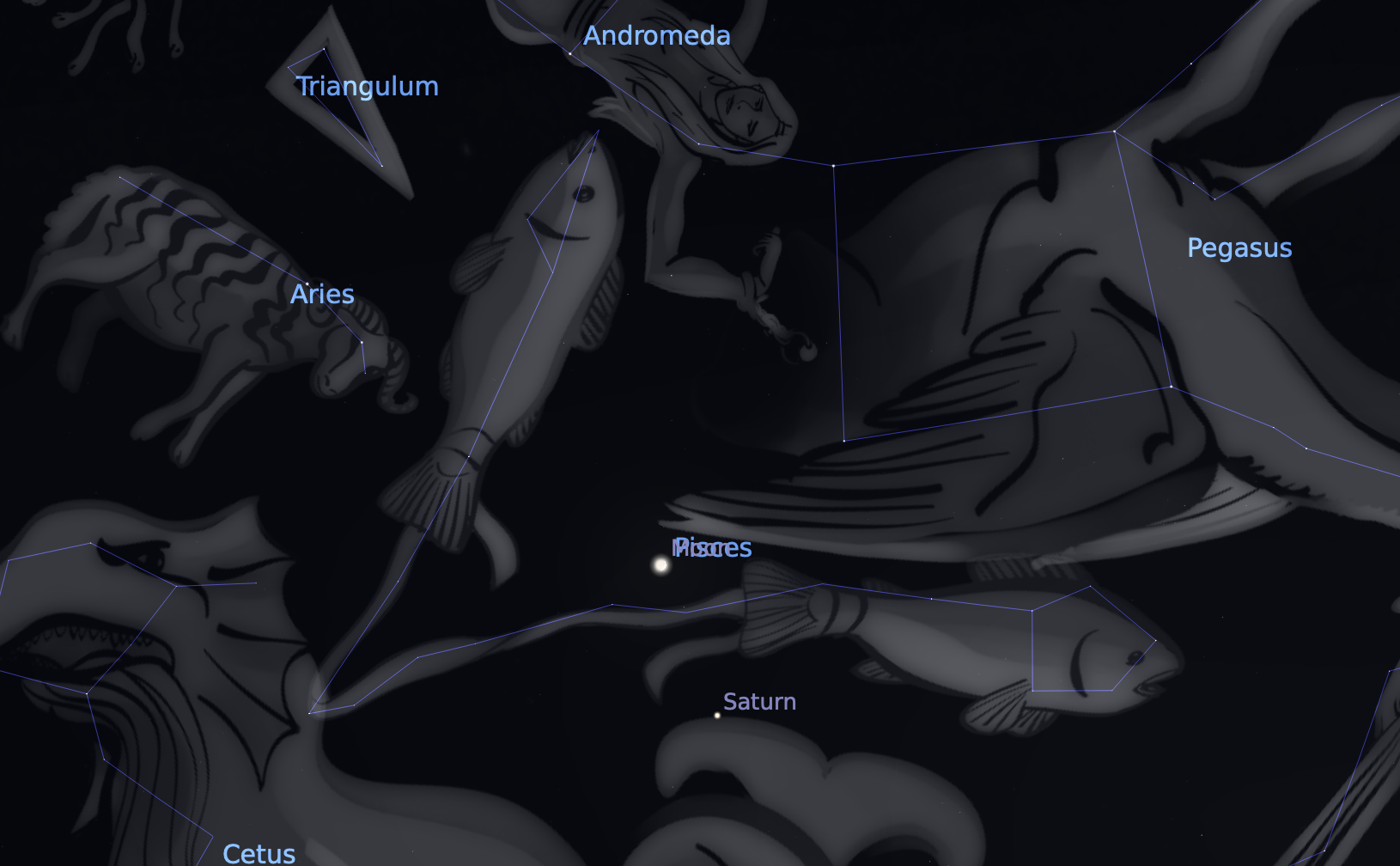
The Constellations That We Think We Know
Greek and Roman Origins
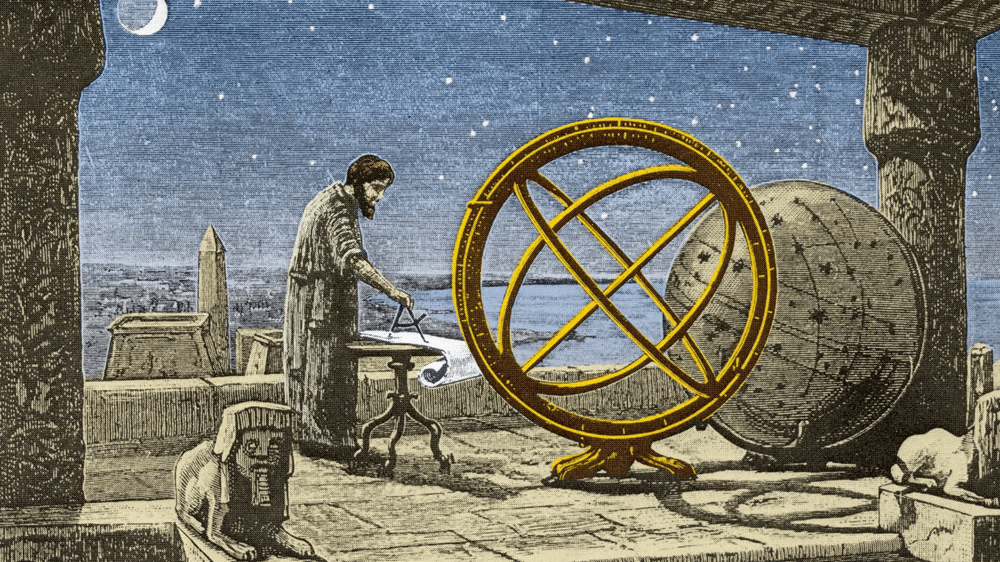
Greek and Roman mythology comprises of stories of the main twelve gods; Zeus, Poseidon, Hades, Hera, Demeter, Apollo, Artemis, Dionysus, Hermes, Hephaestus, Athena, and Ares. The constellations are based on the stories that were told in the ancient Greek religion. The Romans took over their religion and made it their own with new names (like Jupiter for Zeus). The Roman origins are altered from the Greeks to be more aggressive, but their stories still tell the same kind of plots and lessons
Constellation List:
Orion Family
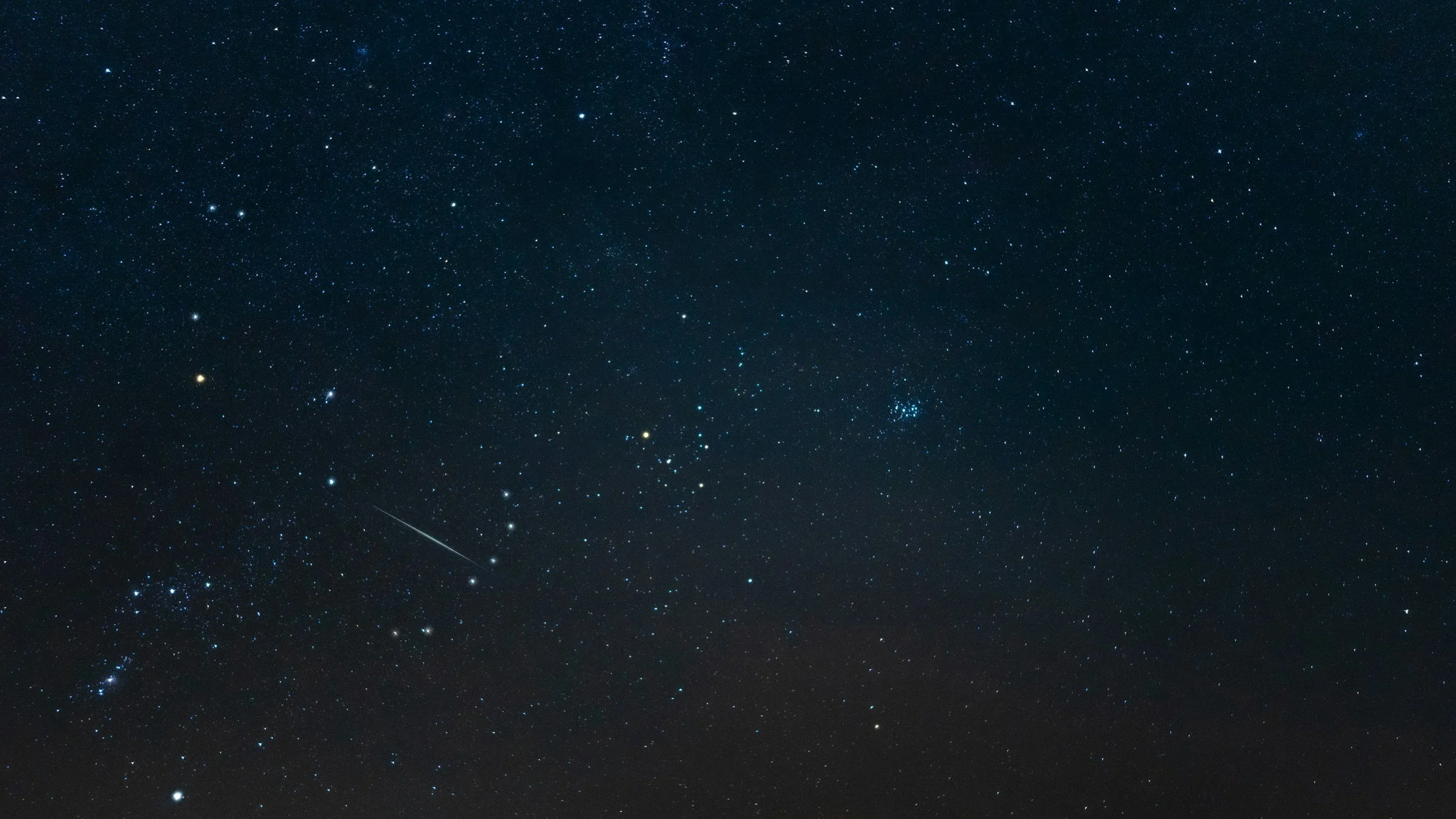
These constellations are grouped together to portray the hunting party of the infamous hunter, Orion.
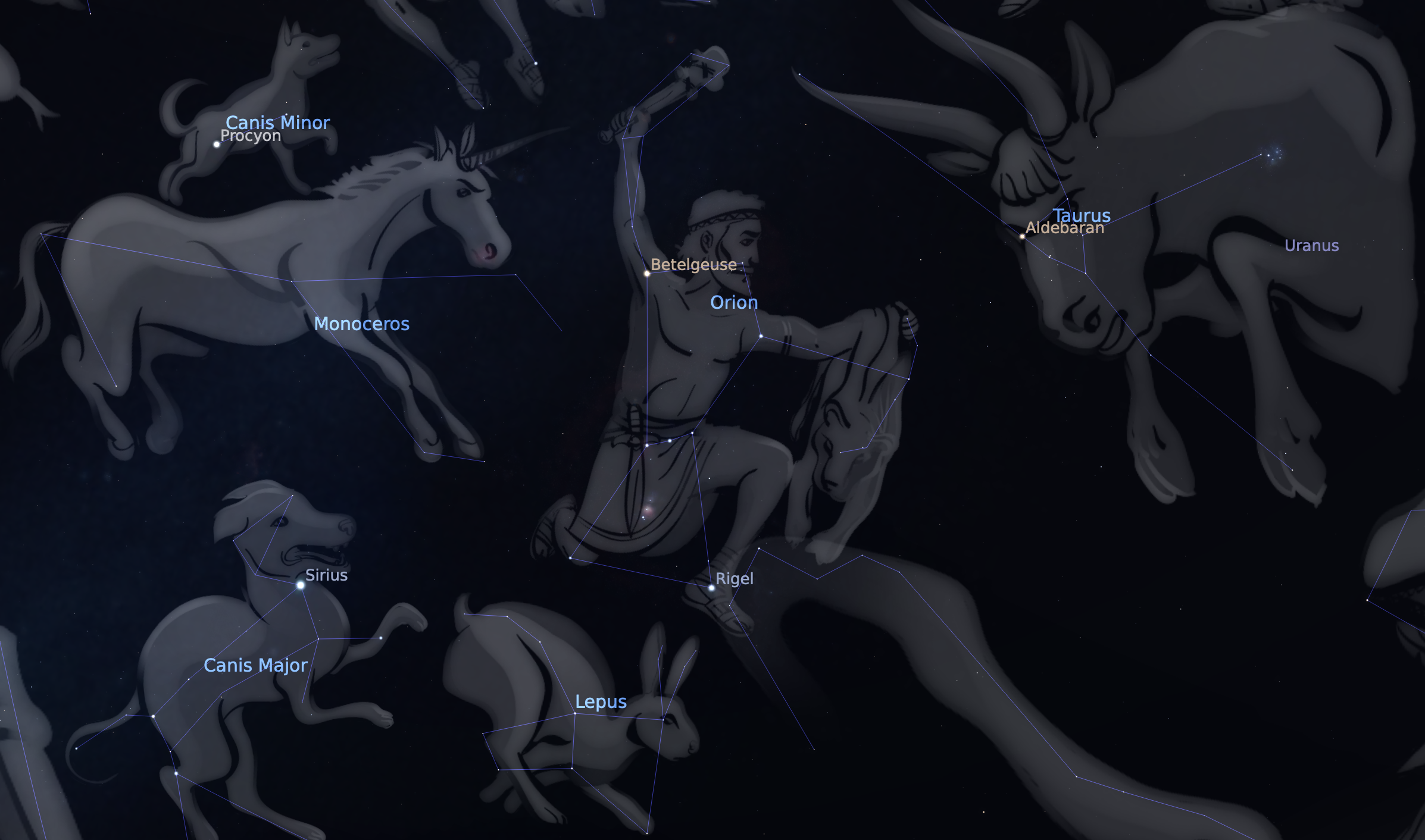
Canis Minor: Canis Major’s pup following along with Orion and Canis Major on the hunt.
Lepus: The hare that Orion is supposedly chasing.
Monoceros: The unicorn.
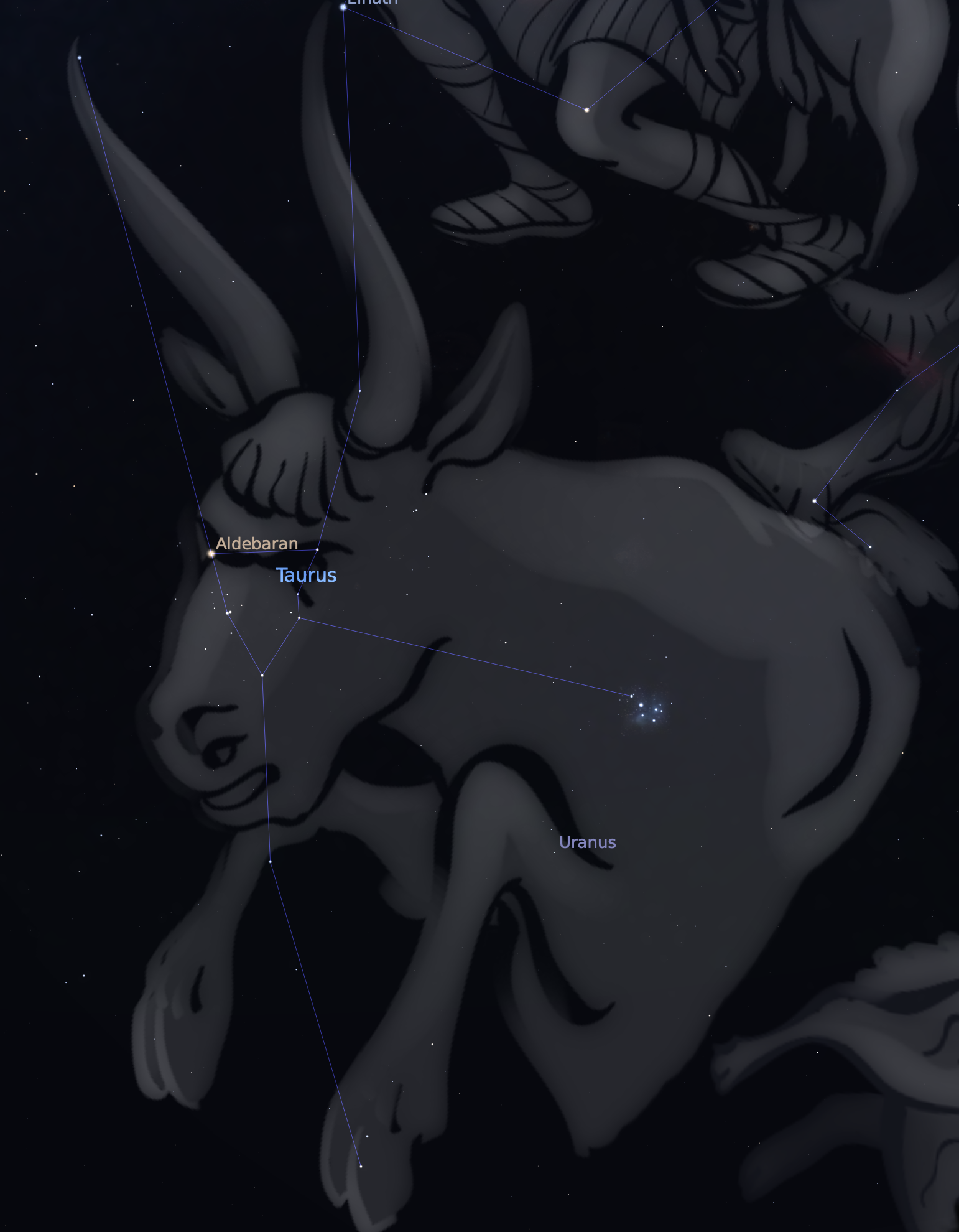
Taurus: It is said in some cultures or variations of this original Greek story that Orion is actually holding a bow and arrow that is aimed at Taurus the bull as his prize.
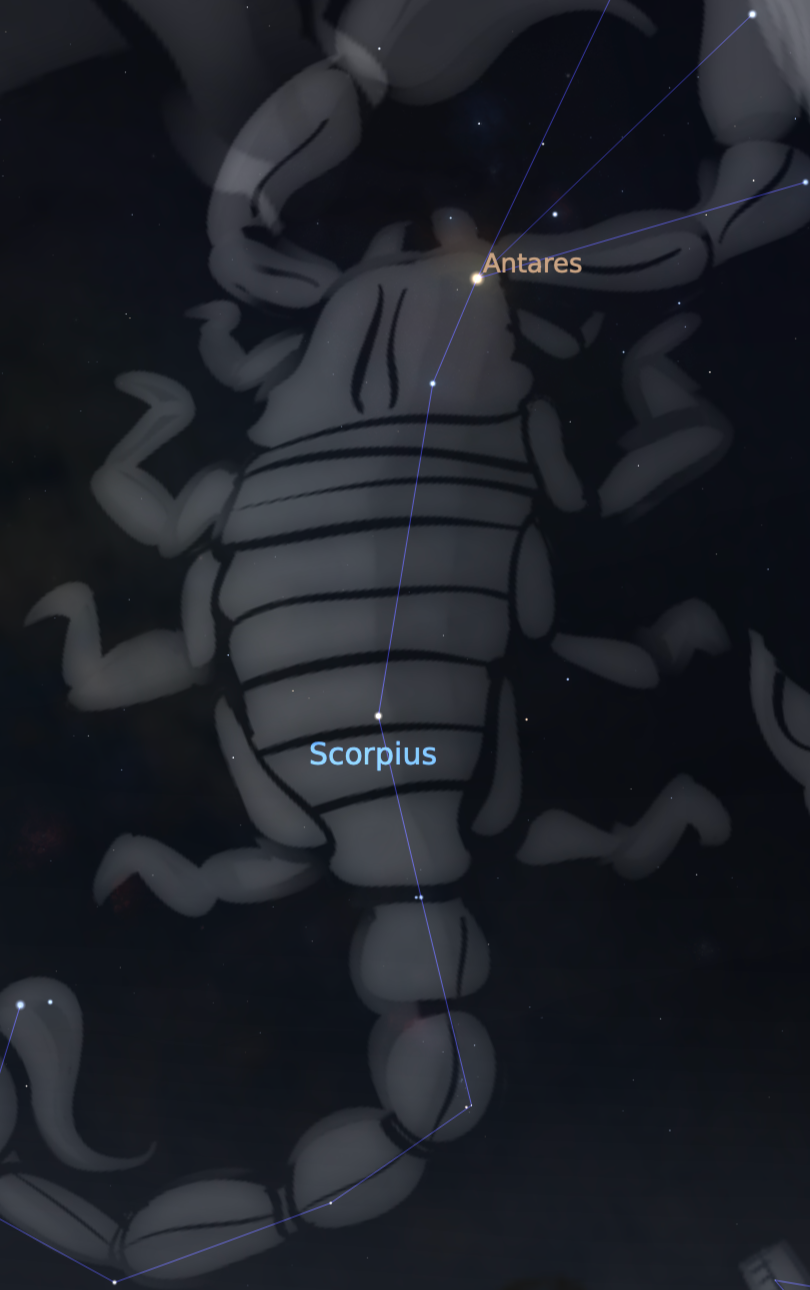
Orion: A very strong hunter, son of a Gorgon and Poseidon, is seen as holding a lion carcass. According to myth, Gaia, Earth herself, sent a Scorpion (yes the one you are thinking of) to kill him. According to myth, this is why Orion and Scorpio are never in the night sky at the same time. Orion is well known and identified by his 3 star belt and some of the brightest stars in our sky, including Betelgeuse, Bellatrix, and Rigel (in his toe!).
Canis Major: Loyal hunting dog of Orion. Can always be found right behind him in the sky. If you follow the line of Orion’s belt down to Sirius, the brightest star in our sky, you can find his loyal dog.
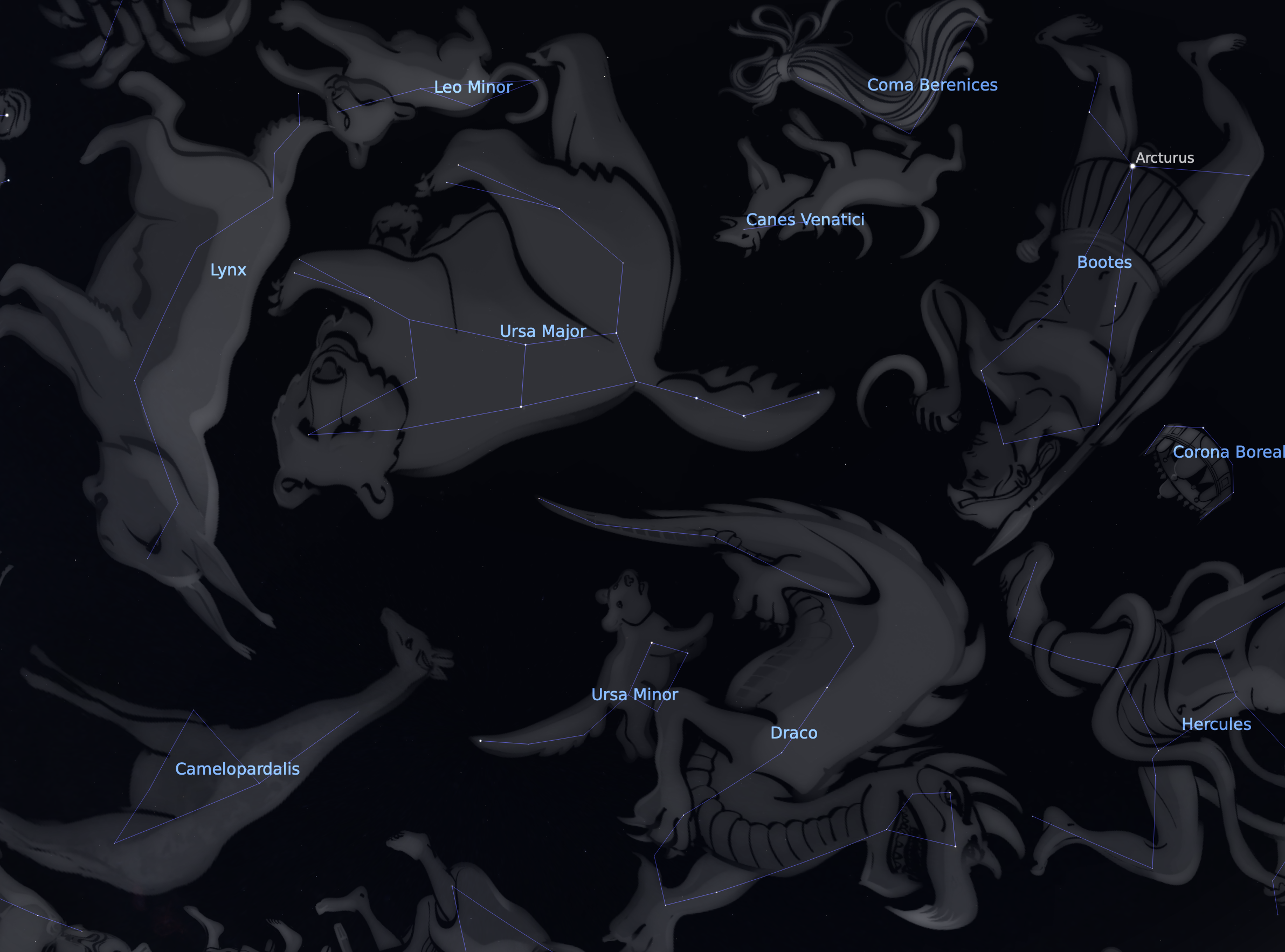
Ursa Major: Otherwise known as the “Big Dipper,” Ursa Major is portrayed as a bear. As myth goes, Hera transformed a wood nymph into a bear in a fit of jealousy. This constellation is easily identifiable in the night sky, especially in the winter in the northern hemisphere. The dipper itself is shown as “pouring” into the “Little Dipper.”
Ursa Minor: The little bear or “Little Dipper” is the child of Ursa Major and can always be found close to their mother. Ursa Minor contains the North Star at the tip of their tail or the end of the handle. Following wherever the North Star, Polaris, is in the sky will lead you north. (Fun Fact: millennia ago, and millennia from now, Polaris wasn’t and won’t be our most North Star.)
Draco: The dragon, who represents a lot of different dragons in Greek myth, is circumpolar and who’s tail is always wrapped partially around Ursa Minor. The most popular myths attached to this constellation refers to either Athena defeating a Giant Dragon and throwing it into the sky OR as Ladon, who guards the golden apples in Hesperides. When Ladon was killed by Hercules, Hera put him in the sky.
Canes Venatici: Pair of dogs that follow Boötes.
Boötes: Greek myth is unclear about who this constellation represents. The most popular depiction is that he is a son of Demeter and became a plowman.
Ursa Major Family
It is grouped this way because they are the most northern constellations that surround Ursa Major and Ursa Minor.
Coma Berenices: The name means “Berenice’s hair,” which refers to Queen Berenice II who sacrifices her long hair. This constellation is the only remaining current constellation that is named after a historical figure.
Corona Borealis: Means northern crown and is said to be the crown that Dionysus gave to the Cretan princess Ariadne.
Camelopardalis: Despite what the name might imply, this constellation is not a camel and in fact means giraffe. This constellation was added far after the rest of the Greek/Roman constellations and doesn’t have a particular myth attached to it.
Lynx: Similar to Camelopardalis, this animal was portrayed in the sky after the main Greek/Roman constellations. However, it is said that, because of its faintness, it challenges future stargazers to see if and claiming that only those who have good sight would be able to recognize it.
Leo Minor: The little lion is portrayed right above their parent, Leo. They are right on top of Leo’s head.
Perseus Family
It is grouped this way because of the myth of Perseus
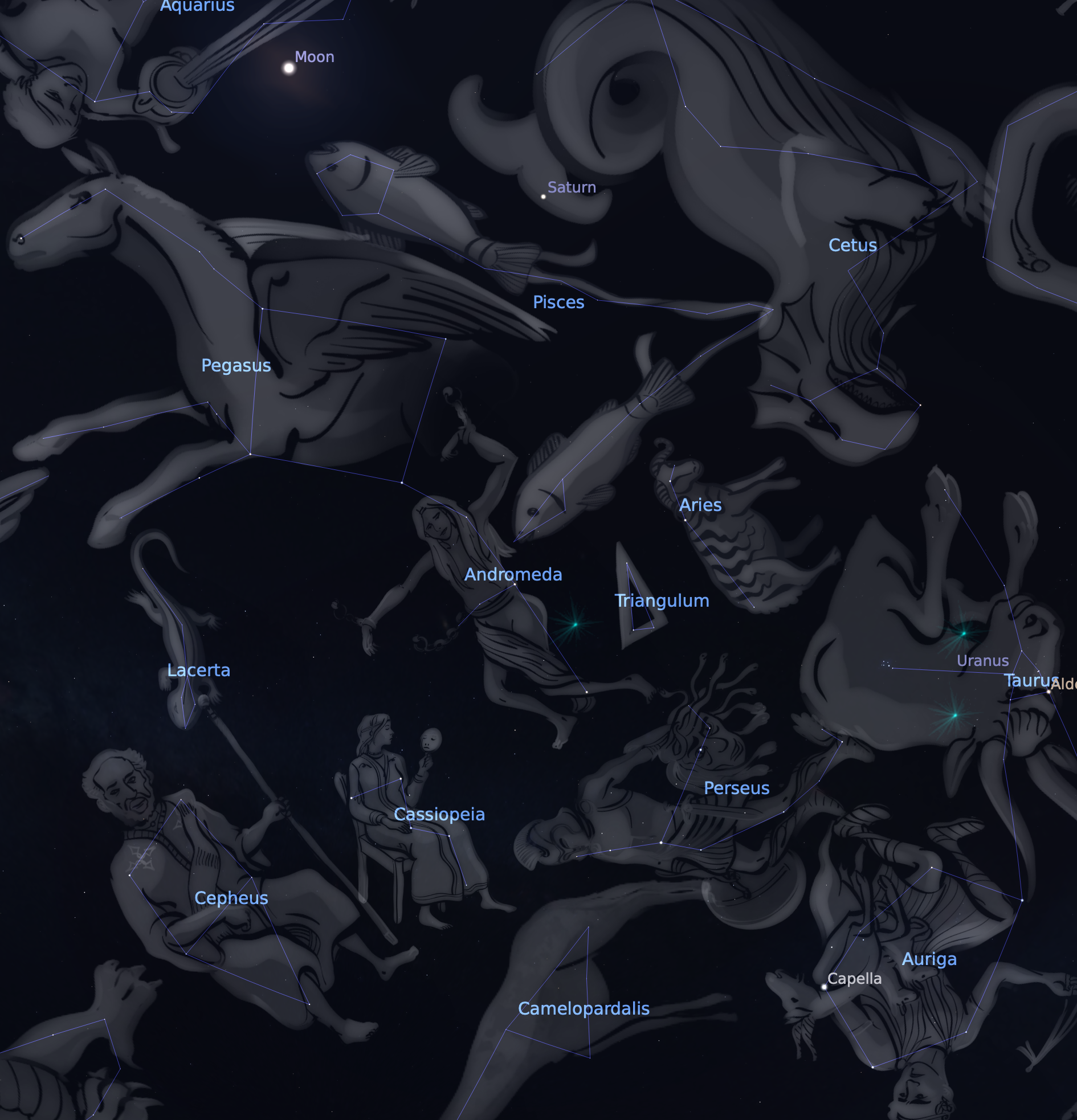
Cassiopeia: The queen of Aethiopia, wife of King Cepheus, and mother of Princess Andromeda. They were all put in the sky next to each other. She was put in the sky as punishment for enraging Poseidon.
Cepheus: King of Aethiopia, husband of Queen Cassiopia, and father of Princess Andromeda.
Andromeda: Known as the “chained woman.” In the Perseus myth, Cepheus was told by an oracle to sacrifice her to the creature Cetus. She was chained to a rock by the sea.
Perseus: Rescued Andromeda from the rock and Cetus and supposedly used Medusa’s head to turn the monster into stone. Later married Andromeda.
Pegasus: A winged horse with magical powers that was born out of the head of Medusa after Perseus decapitated her.
Cetus: The sea monster that Poseidon set upon Aethiopia in retaliation for Cassiopia offending the sea nymphs.
Auriga: Often identified as the hero Erichthonius of Athens. He was the inventor of the four horse chariot, which he rode at an event that made him the King of Athens.
Lacerta: The little lizard.
Triangulum: Means triangle, but is also a representation of the greek letter delta.
Hercules: Is portrayed above Draco, in order to show him stomping on the dragon’s head.
Ophiuchus: Is positioned in the sky halfway between Orion and Scorpius because he saved Orion by getting him the antidote. Is Orion’s protector.
Serpens: Always shown in Ophiuchus’s hands, the snake is a symbol of rebirth in Greek mythology because it sheds it’s skin.
Lyra: Represents the Lyre of Orpheus, who was famous for his music which was said to be so powerful that inanimate objects would be charmed.
Cygnus: Used to depict several different swans in Greek mythology, including Zeus, who disguised himself as a swan to seduce Leda and Orpheus, who transformed into a swan after his murder and placed in the sky next to his instrument.
Vulpecula: The little fox.
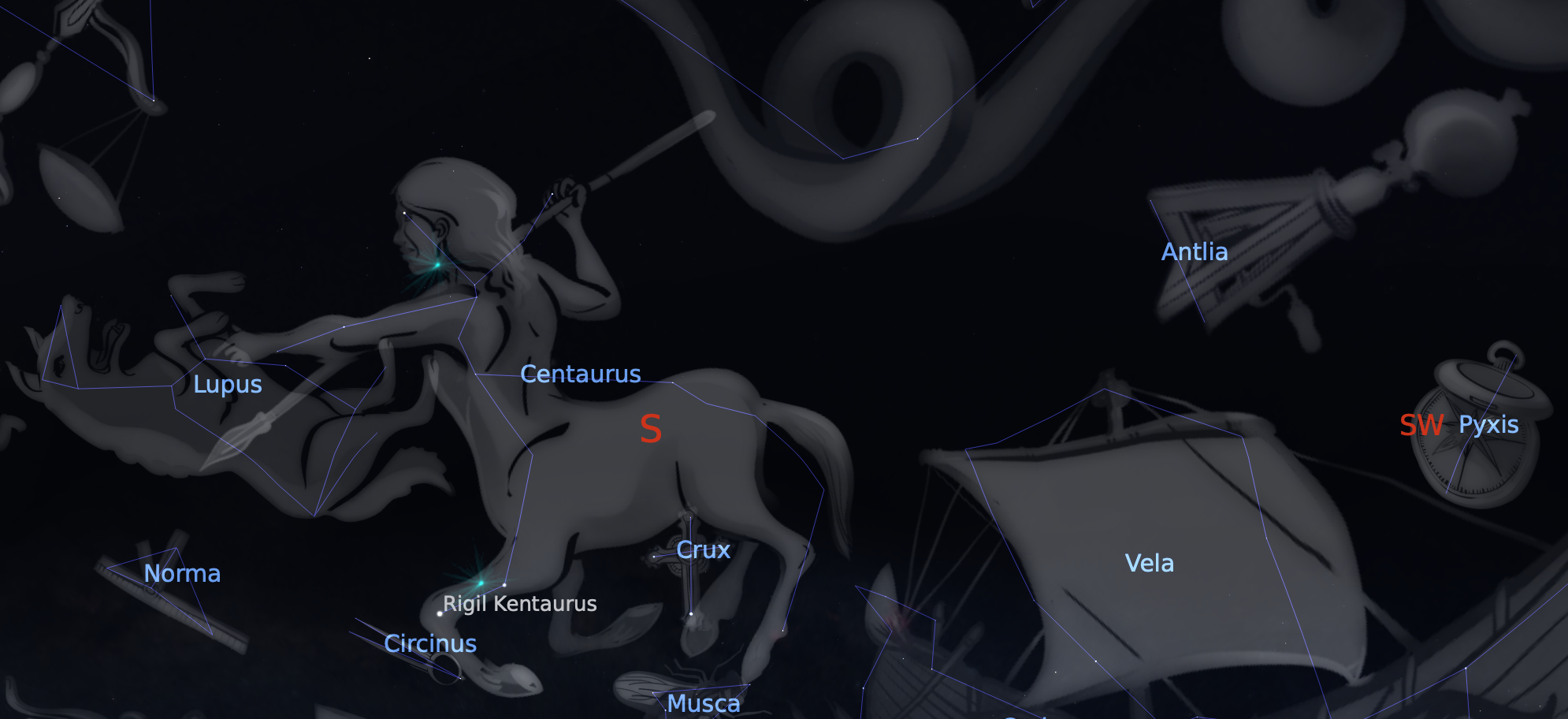
Centarus: The centaur, which is portrayed as attacking Lupus, the wolf. Contains several bright stars including Alpha Centauri, which is the closest star system to the Sun.
Corvus: The crow which is from the myth of Apollo and his lover Coronis, who was unfaithful to him. When he found out about this from a white crow, he turned the feathers black in rage.
Crater: This is a type of cup that was used to water down wine.
Crux: Otherwise known as the southern cross.
Hydra: Associated with its many heads that was defeated by Hercules. Another myth depicts it as a water snake that a crow served Apollo in a cup. Apollo saw through the deception and threw the crow, cup, and snake into the sky.
Sextans: An astronomical device that is used to measure the distance between stars.
Hercules Family
It is mostly grouped this way based on their relative position in the sky
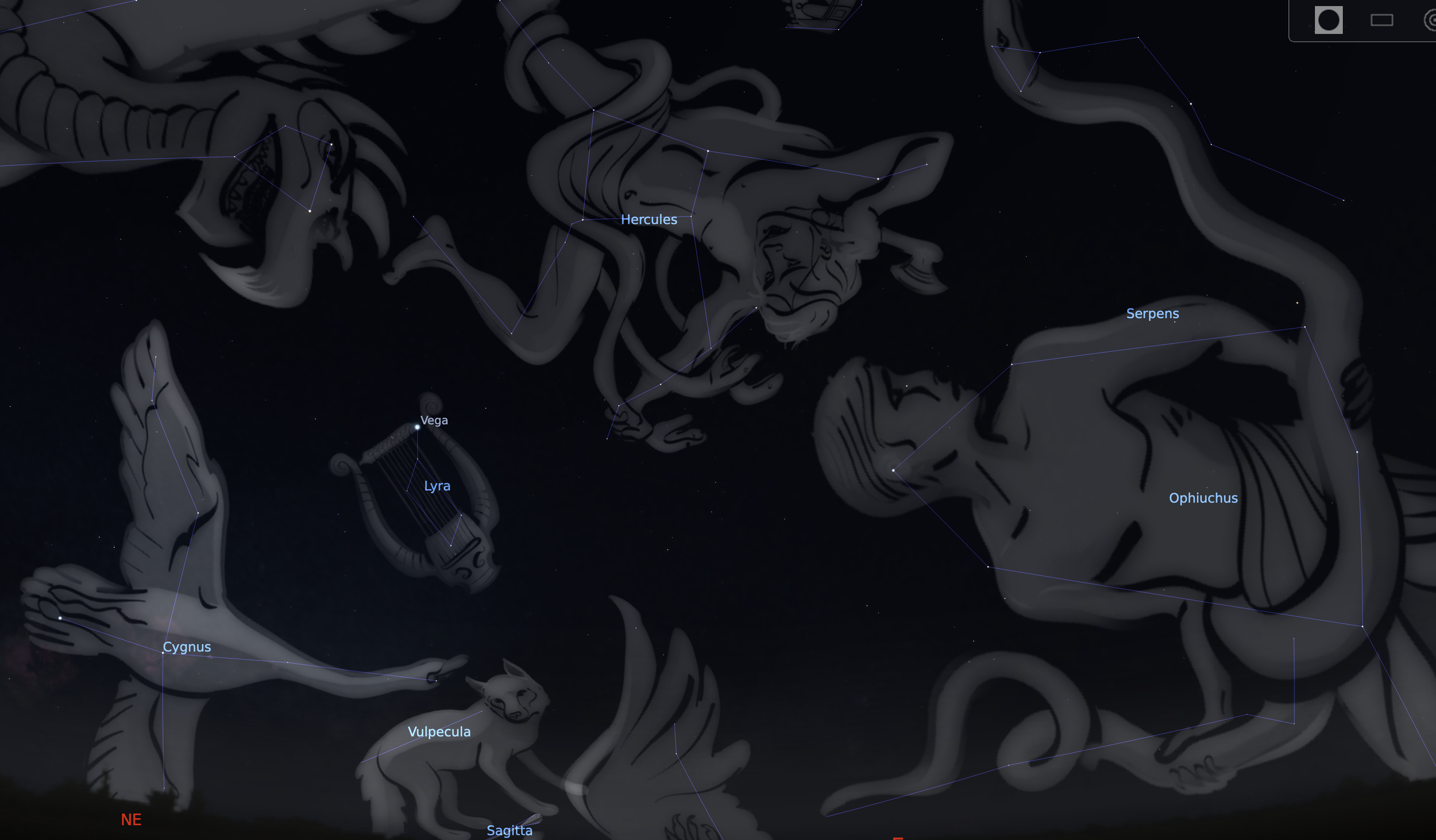
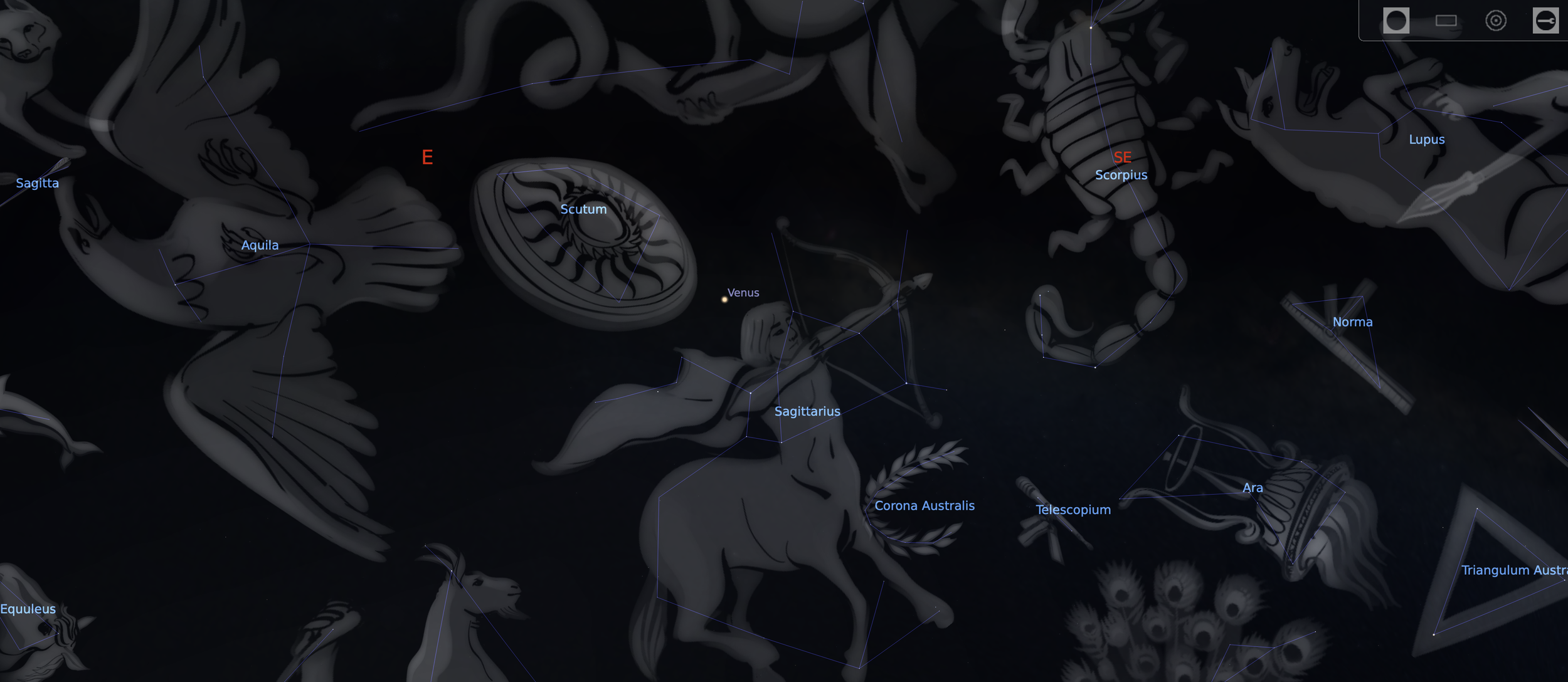
Aquila: The eagle which is sometimes portrayed as holding Zeus’s/Jupiter’s infamous thunderbolts. Also associated with the eagle that kidnapped a son of one of the kings of Troy.
Sagitta: Otherwise known as an arrow and is often identified as the arrow that Hercules used to kill the eagle of Jove (which would continuously eat at Prometheus’s liver).
Scutum: Portrayed as a shield.
Corona Australis: The southern crown, whereas the Corona Borealis is the northern crown.
Ara: The alter where the gods first made offerings and worked together to beat the Titans.
Triangulum Astrale: Otherwise known as the southern triangle
Lupus: The wolf, often portrayed in greek mythology as the “mad man dog.”
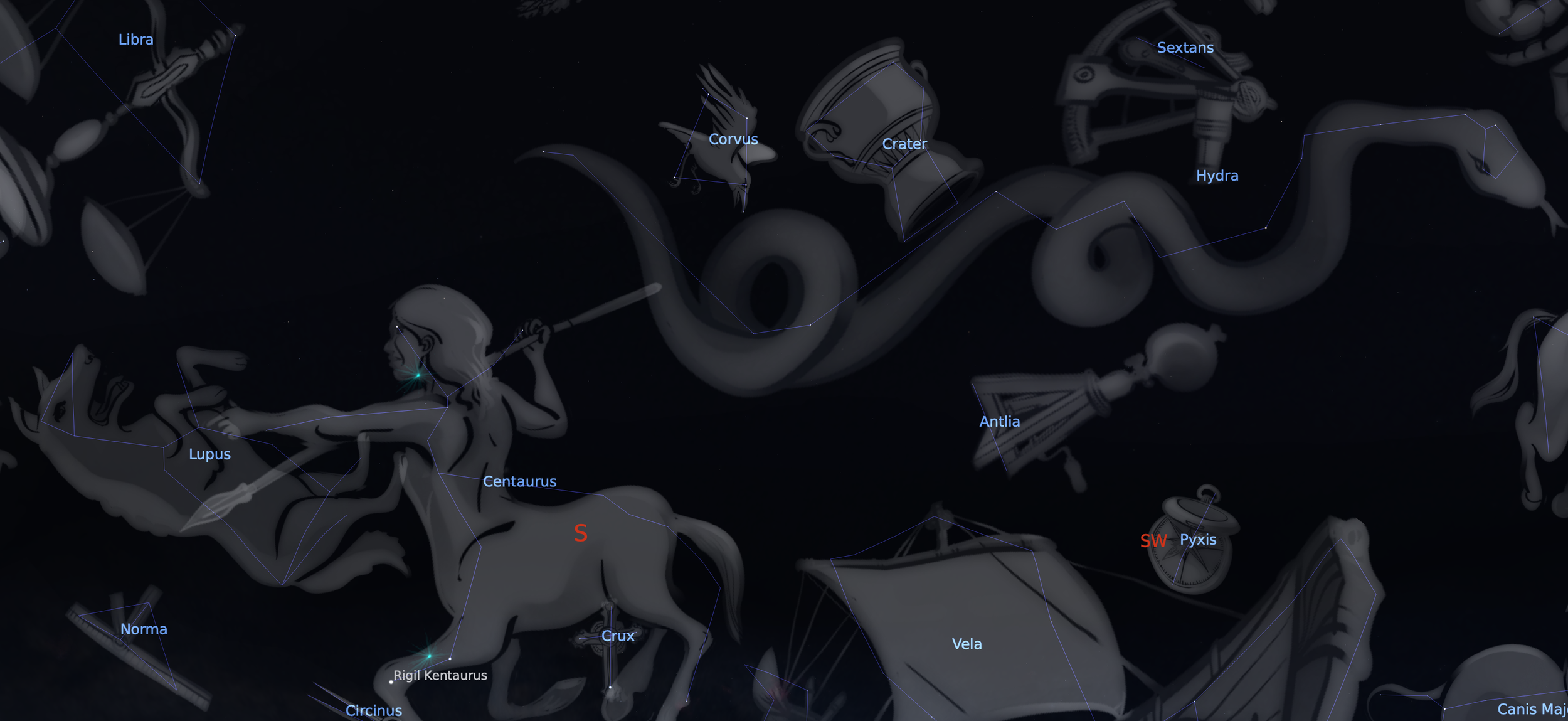
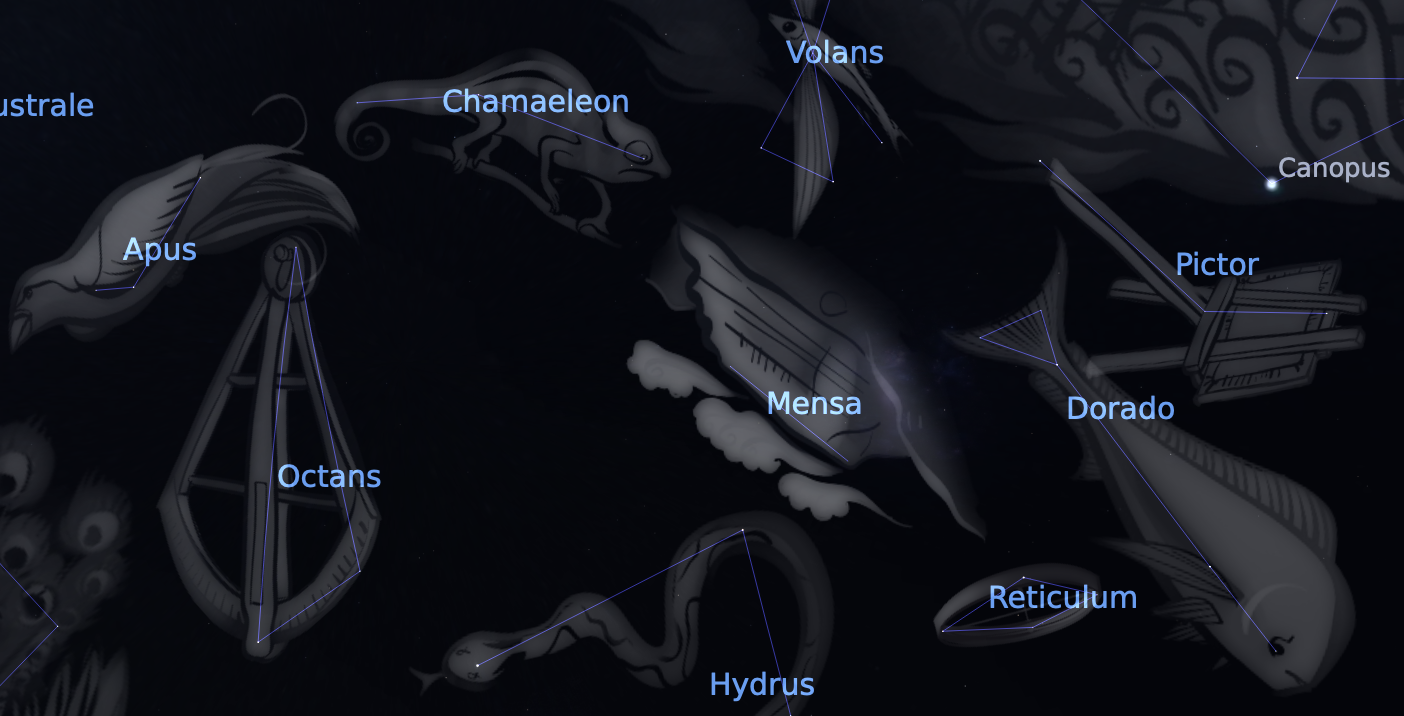
Hydrus: Otherwise known as the water snake.
Dorado: The dolphinfish that are golden colored and are sometimes referred to as goldfish.
Volans: A tropical flying fish that can jump out of the water and glide through the air on its wings. Associated with the Argo ship in Greek mythology.
Apus: Bird of paradise. The name means “without feet” because it originally was thought to not have feet.
Pavo: The peacock. In Greek mythology, this constellation used to be Argos who was the builder of Jason’s ship, the Argo.
Grus: The crane.
Bayer Family
These constellations were mostly grouped together because of the exotic animals.
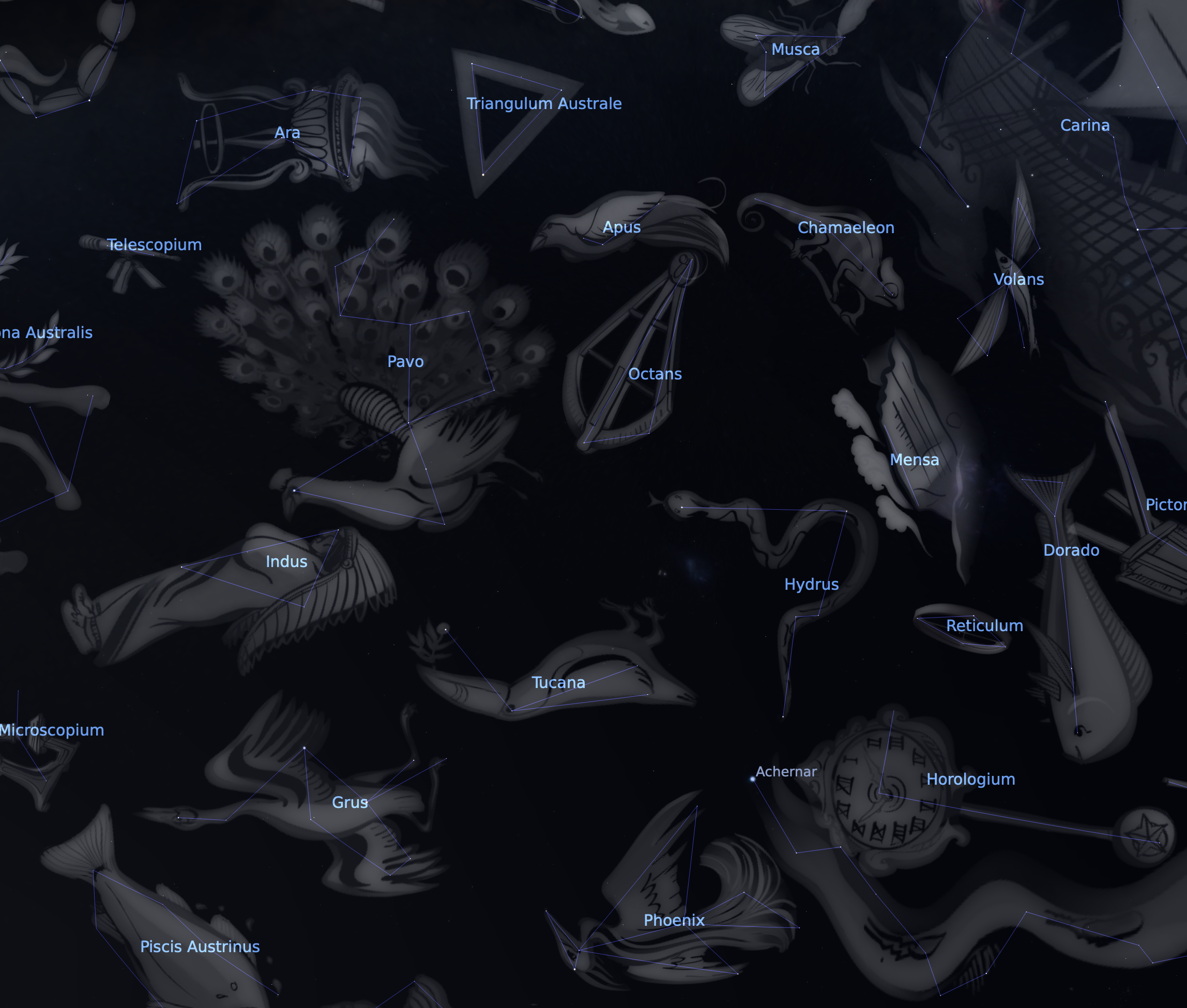
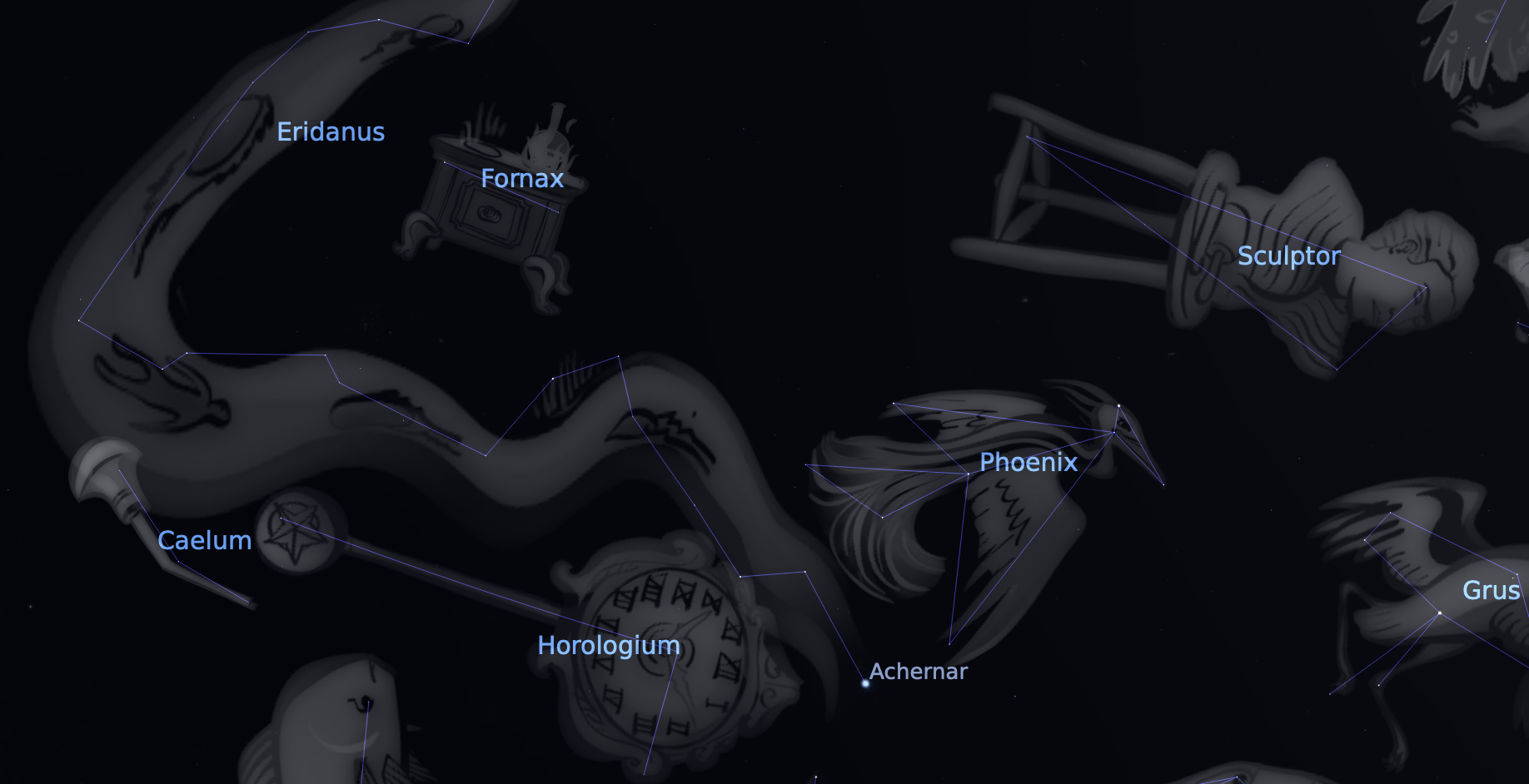
Phoenix: A mythical creature that symbolizes rebirth. The phoenix will burn up when it is time to die and then be reborn from the ashes.
Tucana: The toucan.
Indus: The Indian/Native American. Not part of Greek mythology.
Chamaeleon: Based on the lizard, chameleon.
Musca: The fly, which is portrayed near the Chamaeleon as its future food.
Antlia: Represents an air pump.
Norma: Represents multiple different tools including a ruler, a carpenter’s square, a set square, and a level.
Circinus: Represents a pair of dividing compasses, a drafting tool used for drawing circles.
Horologium: Otherwise known as a pendulum clock.
Fornax: Otherwise known as a furnace.
Caelum: Otherwise known as a chisel.
Sculptor: Represents a sculpture of a sculptor.
La Caille Family
These constellations were so dim that the ancient Greeks and Romans could not see them so they were added later. All of these are some kind of science technology.
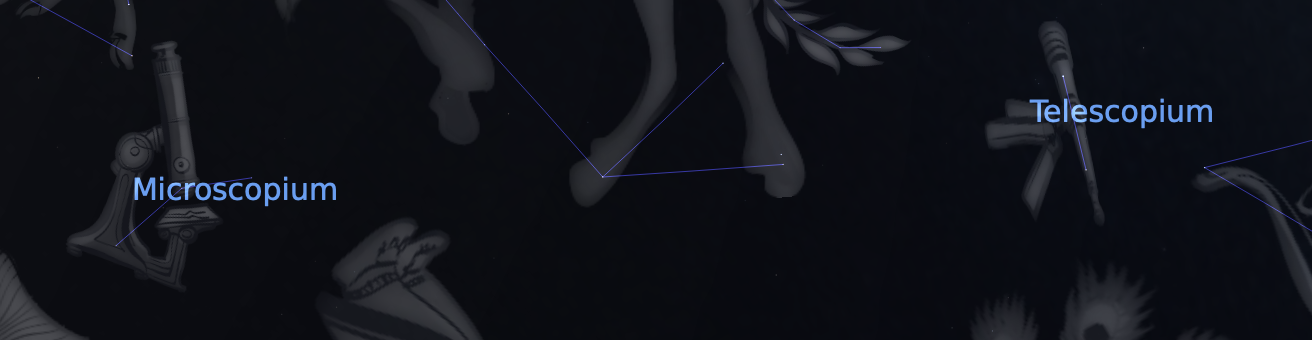
Microscopium: Represents a microscope.
Telescopium: Represents a telescope.
Mensa: Represents a table mountain.
Pictor: Otherwise known as a painter’s easel.
Reticulum: A net of crosshairs at the focus of a telescope eyepiece that is used to measure star positions.
Octans: Represents an octant, a navigational instrument.
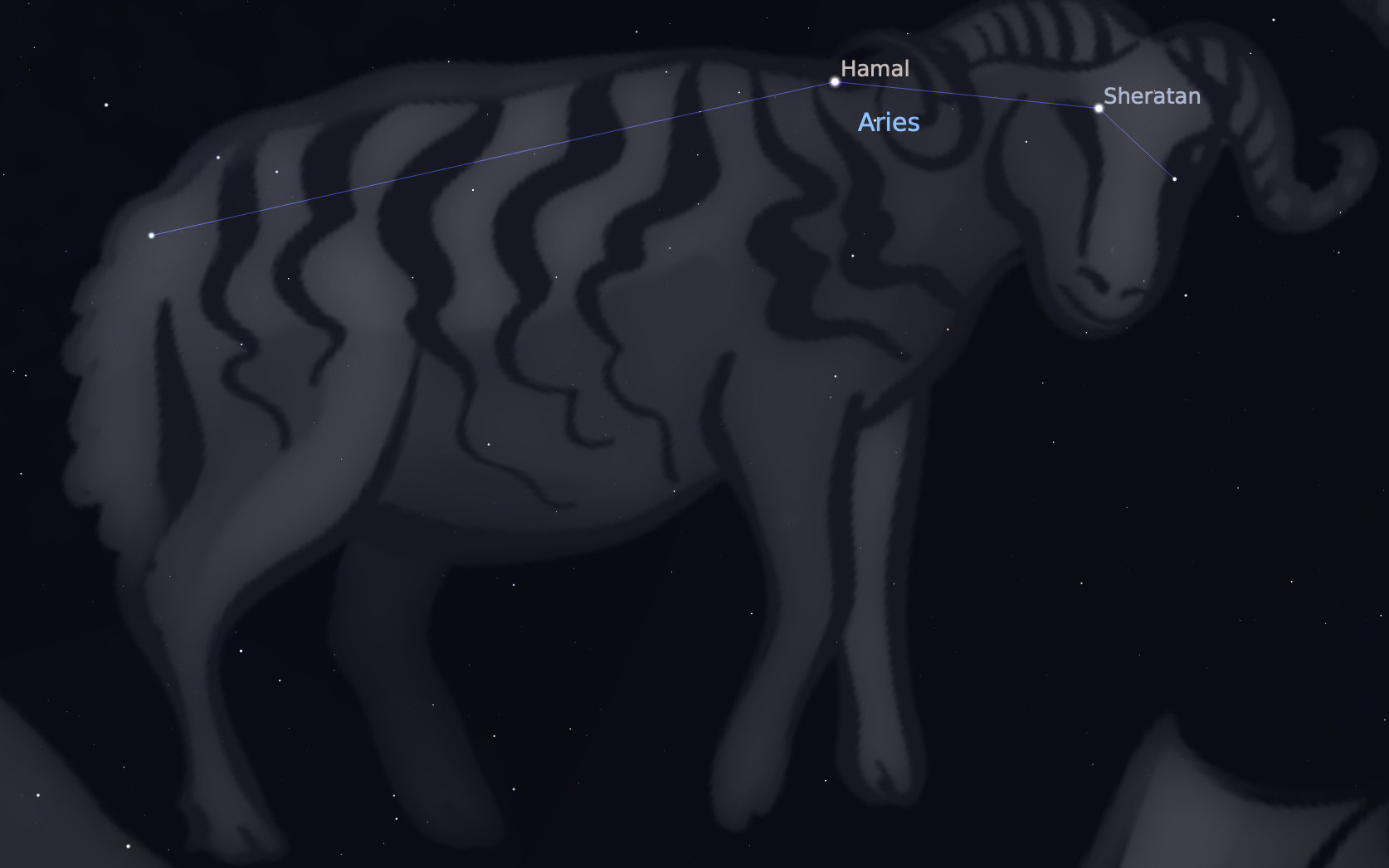
Aries
Zodiac Signs
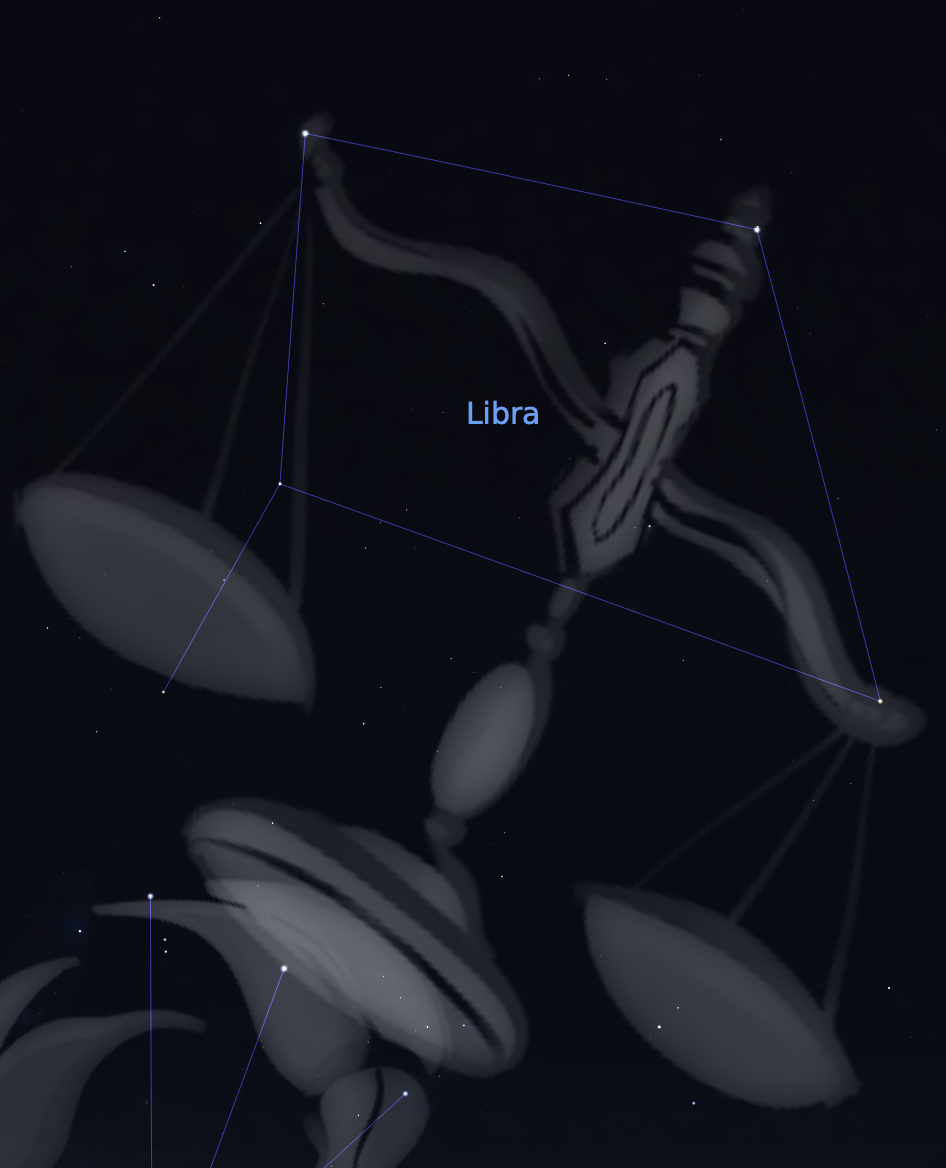
Libra
Taurus
Scorpio
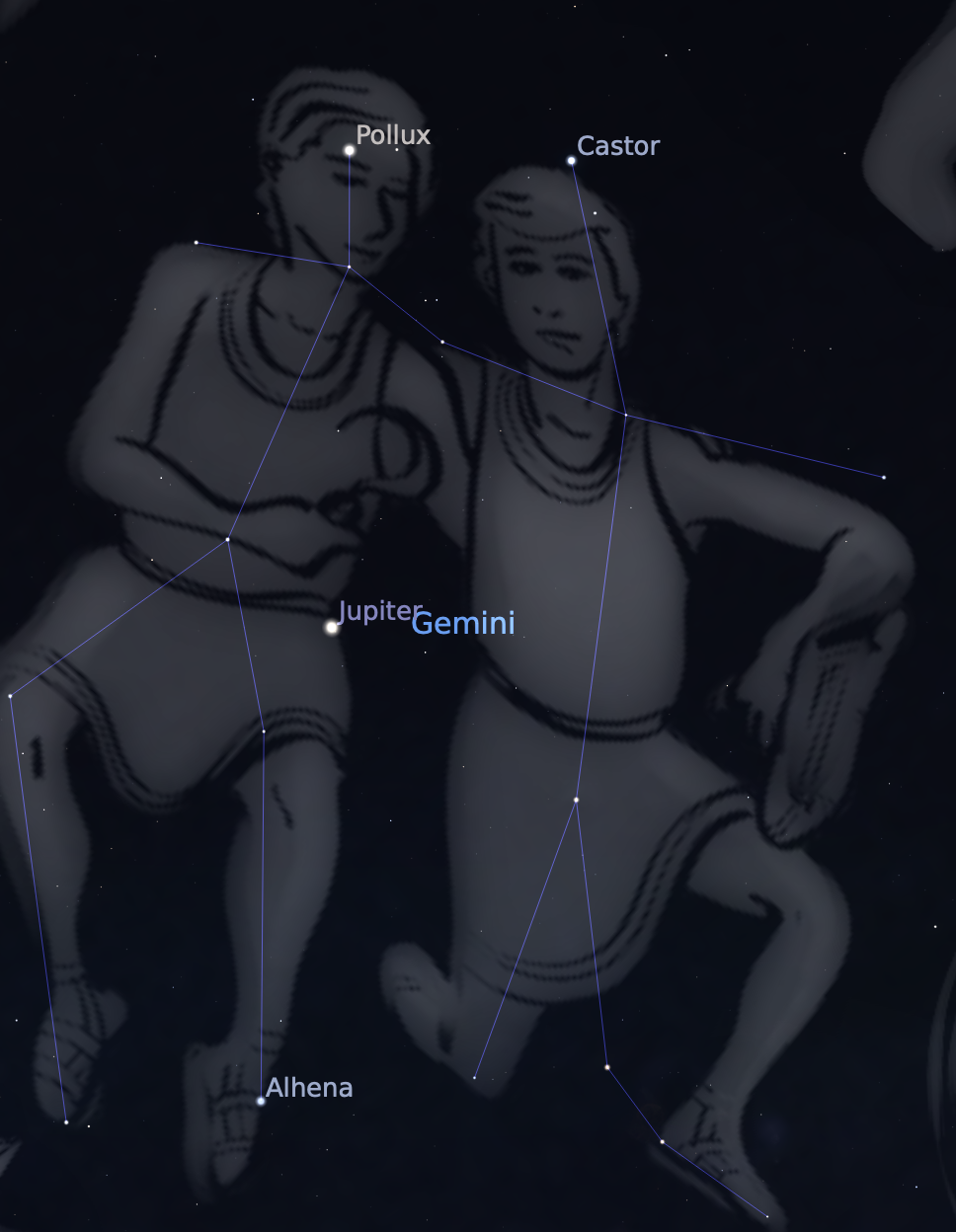
Gemini
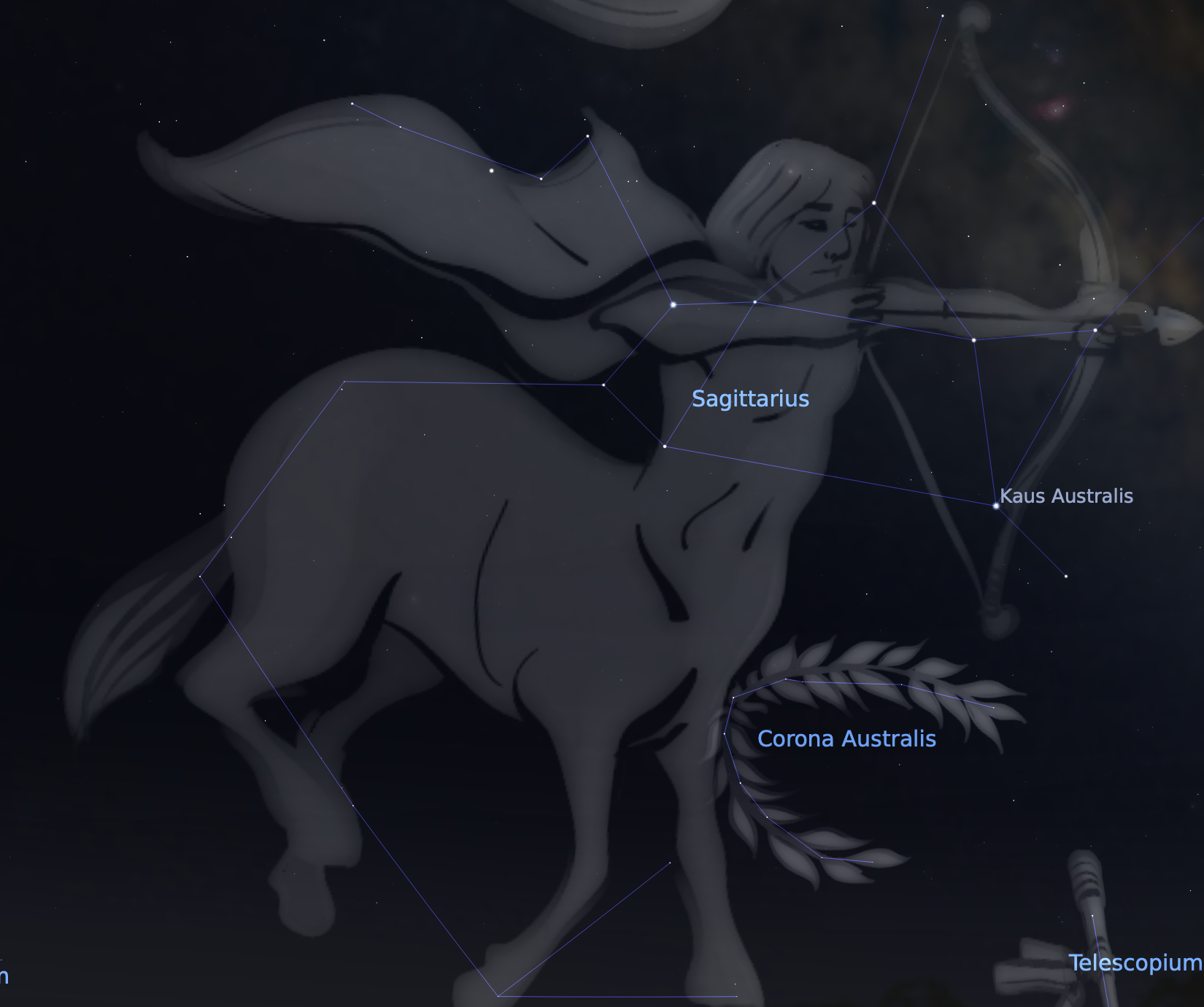
Sagittarius
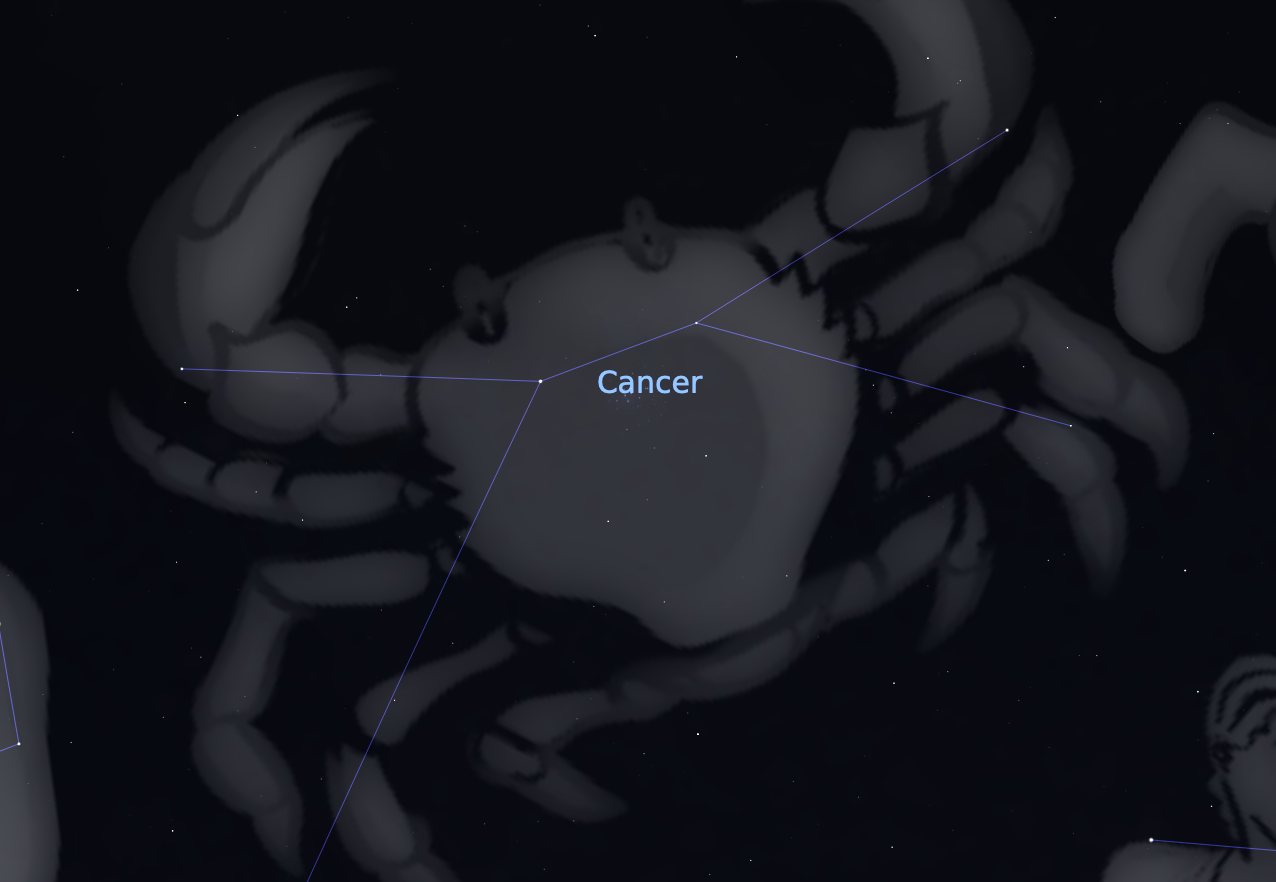
Cancer
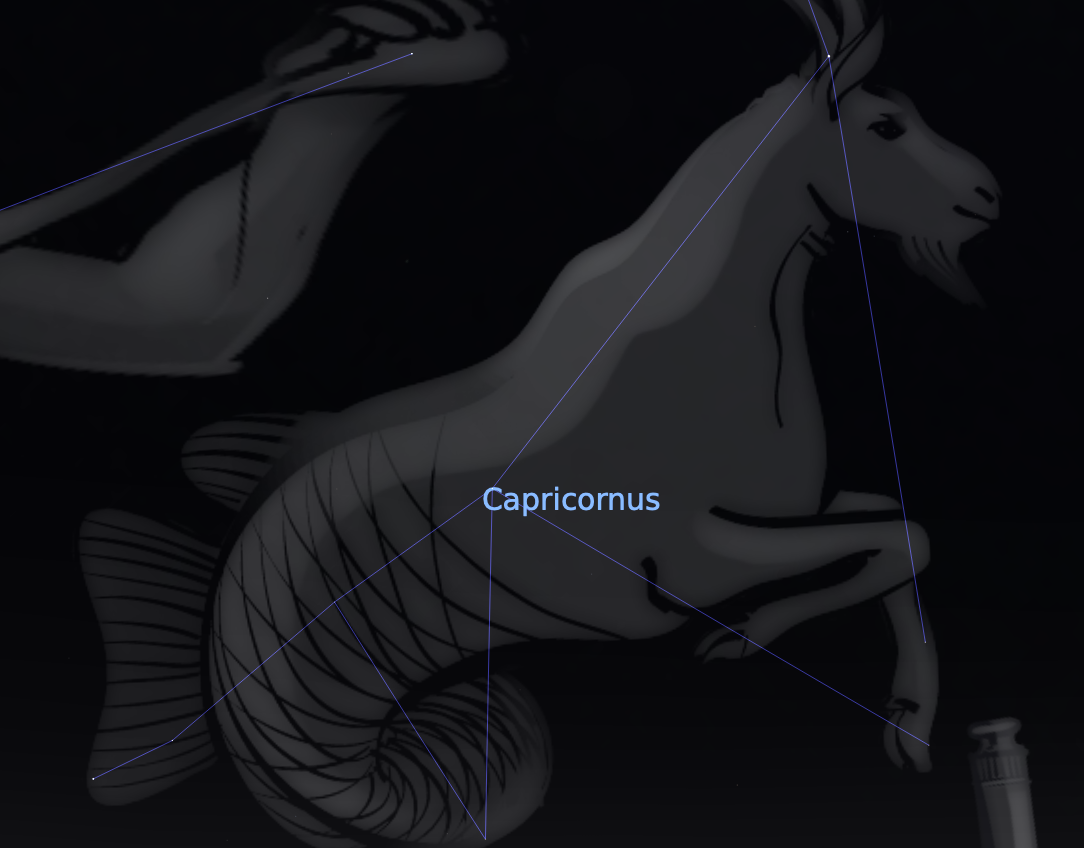
Capricornus
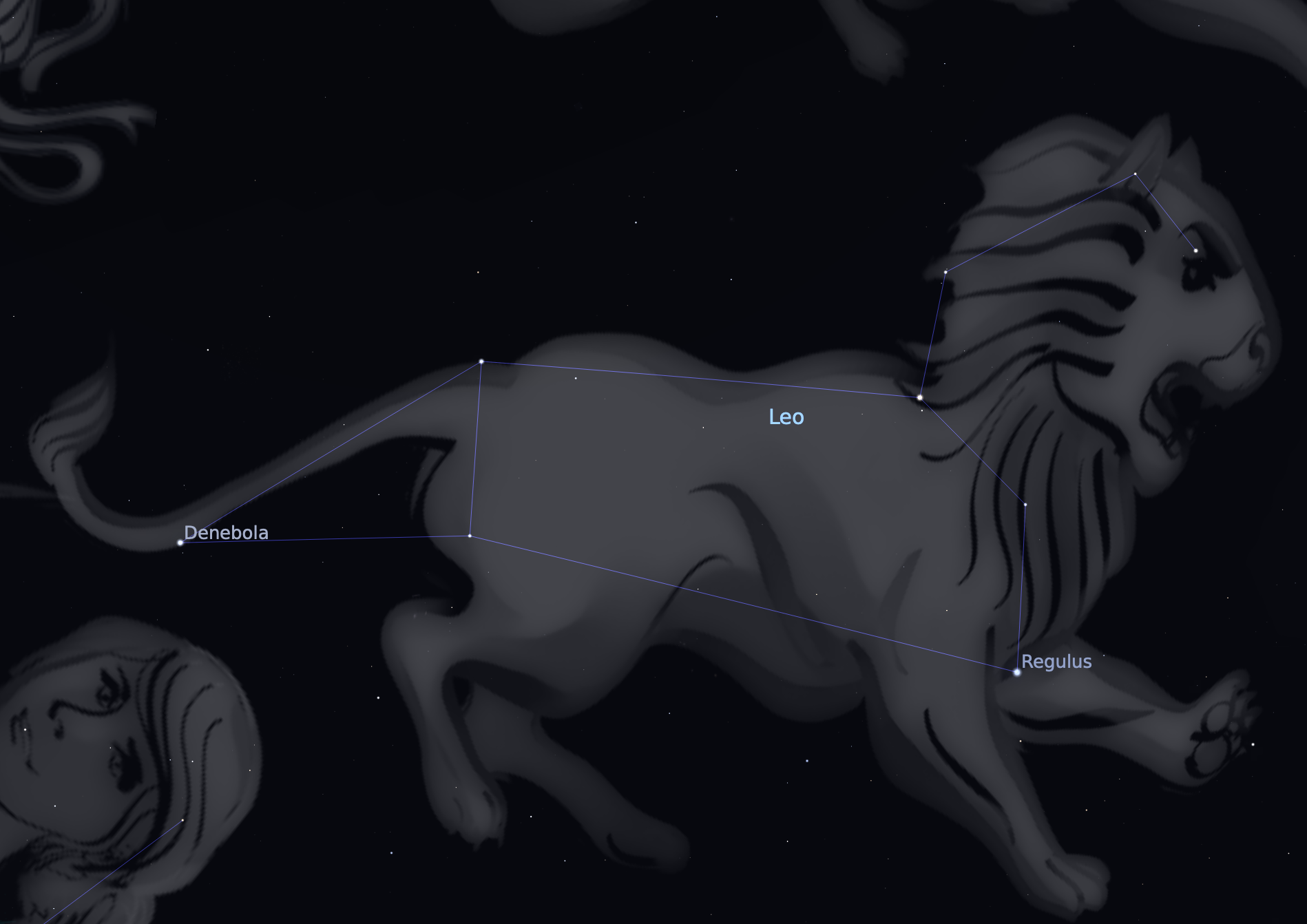
Leo
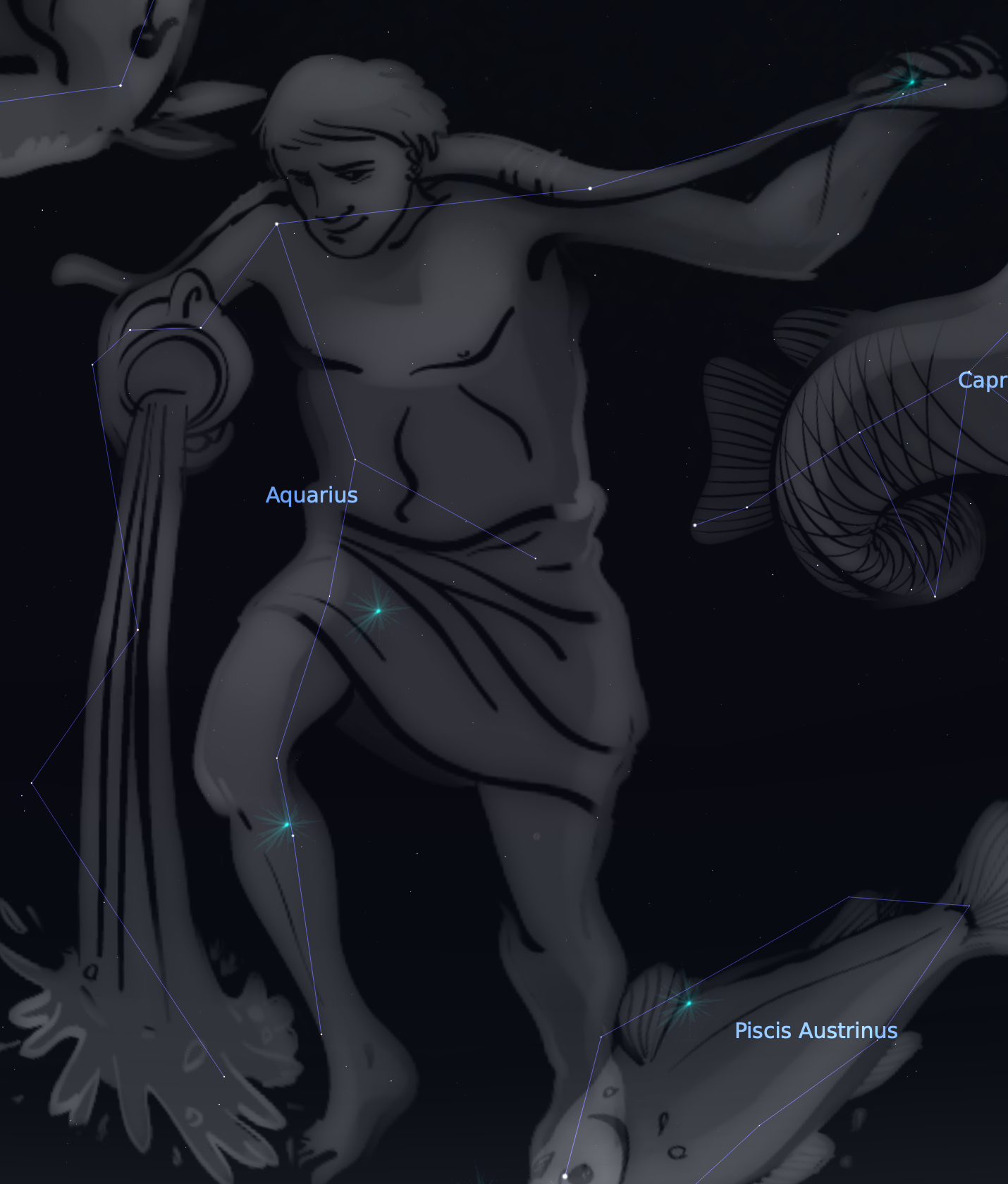
Aquarius
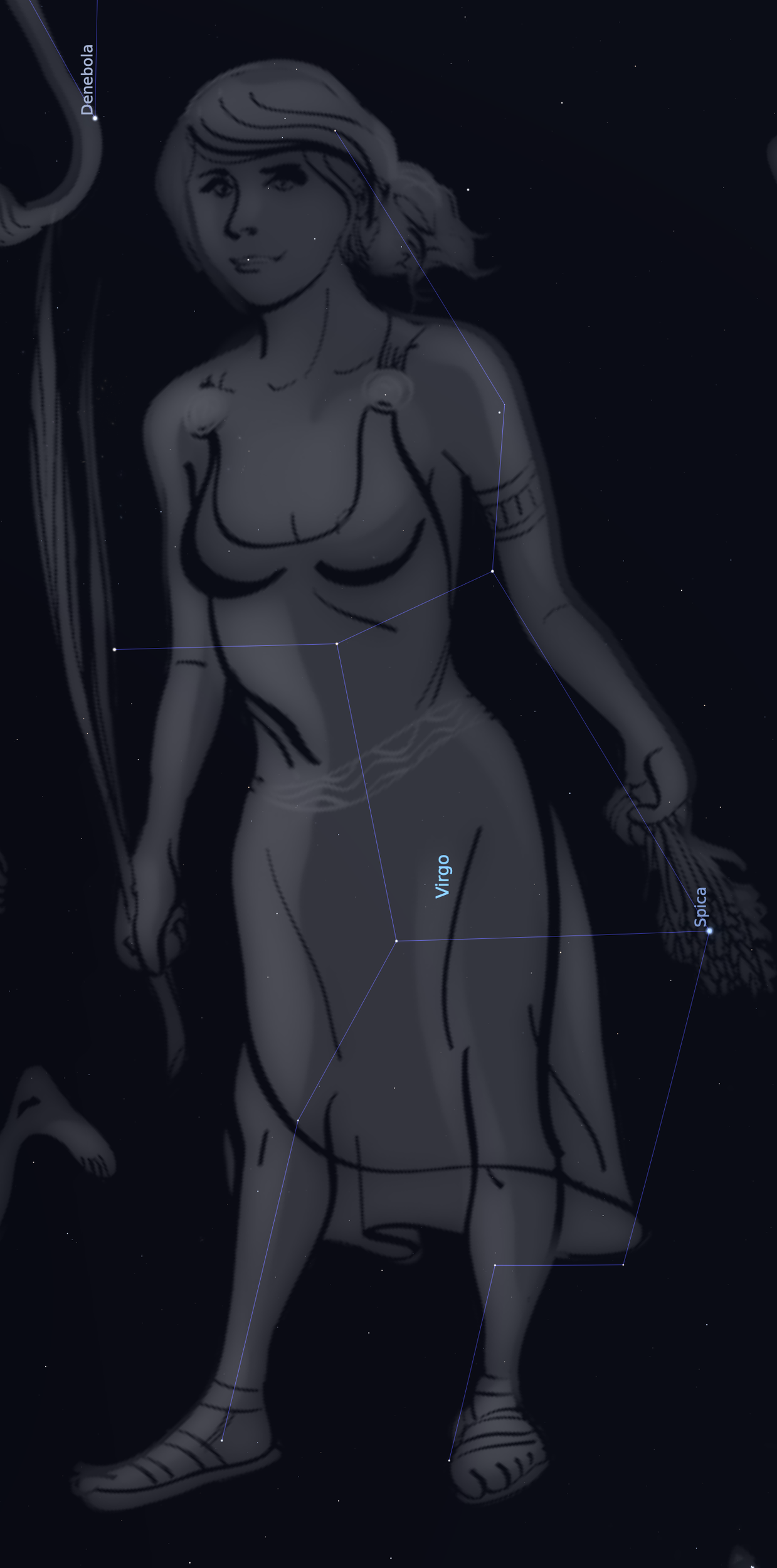
Virgo
Pisces